Tuesday, March 22, 2011

Herb for Bees - Autumn food !

Lemon verbena or Aloysia citrodora would be one of my most favorite herbs. It is flowering profusely in the Herb Garden at Hamilton Gardens, filling the area with its bewitching lemony scent.

 Native to many parts of South America, this plant was taken to Europe in the 18th Century, where it became very popular and used in alot of different cooking styles. In Victorian times it was simply known as `the lemon plant` Today Lemon Verbena is used to flavor meat and fish dishes, puddings, cakes, my favorite being a refreshing drink infused with crushed leaves, left to cool and add soda water for a sparkling beverage !

Along with Solidago (Golden Rod), this beautiful bushy small shrub flowers late summer, early autumn, providing much needed nectar/pollen for honey bees and other pollinating insects, the white/pinkish flowers cover the plant. It does need to be planted in a warm, frost free spot and cut back hard each autumn after flowering as it tends to get straggly - but nothing else can compare with Lemon verbena for the best lemon scent after an actual lemon !

Wednesday, March 9, 2011

Autumn is near . . .

The beautiful vase-shaped hips from Rosa moysii with lots of tiny black seeds ready to fall out everytime you shake them. I remember when my children were babies you could buy rosehip syrup which was diluted with water, providing a great source of Vitamin C ! It most probably was full of sugars ! You can`t buy it now.
I cut one open to taste, it was quite sweet and I would imagine a very nice drink could be made - I must google it ! I have added the remaining hips to my `autumn` collection ..
Allium flowers, bees love these pretty white umbels which planted en mass look rather gorgeous I think. Autumn is my favorite season, I so look forward to the days closing in, mellow golden light, cool temps, leaves changing colour - I know it is the ending of the life cycle for many plants, but I feel so energized and alive !!
Miss Bee coming into land with golden rod filled pollen baskets - the bees in the hives at the Sustainable garden in the Hamilton Gardens are still out and about each sunny day. The solidago is one of the last herbs to flower during late summer/ early autumn here in NZ, everything else in the herb garden having reached the end of their flowering. Lemon balm is flowering profusely at the moment, the smell of the flowers and leaves is divine, I must grow more bushes of it next year.

Sunday, February 27, 2011

A Small Detour into My Past . . .

On the road they call `the Forgotten Highway` which winds its way alongside the Wanganui river from Taumarunui, there is Herlihy`s bluff to negotiate. In the 45 years ( yes . . .45yrs !) since I drove over this now tar-sealed road, there have been afew changes, one being the shifting of the road itself, to a lower level cut out of the cliff side after a person was killed by falling boulders. It has never been a safe place to dally, even with the magnificent views of the river on the other side of the road ! 
The first major change I found on the journey into my past was. . MY BRIDGE HAD GONE !! Far out, I couldn`t believe what I was seeing. Where was the wonderful old wooden Te Maire bridge that you could walk over as well as drive across the rattly boards ?? All I could see was this concrete 2-way eye-sore,(so sad to find the big old end bits sitting amongst the bush on either side) - no character at all, built 8yrs after we left the district. Oh well I thought, nothing else can get any worse  . .  how wrong was I .
Metal, windy valley road, bush-lined for most of the way - old Kahikatea, Totara and Rimu dripping in lichen - cool, a million hues of green - NZ bush I remember. This part was thankfully the same, right down to the tree ferns and sound of Tui. . .
On past the bee hives and angry looking bull, around very tight corners, remembering when my mother, in the family tank (Vanguard car) rounded such corner to collide head on with a horse !! There really isn`t anywhere to pull over, you just have to be extremely good at maneuvering in tiny spaces . . . At the end of the road is the farm `Patunga` where I spent the first 12 formidable yrs of my life - a large sheep and cattle station. Slowly around the last corner I crept, dust flying up behind me, expecting to catch a glimpse of the 102yr old homestead and . . . . . no orchard or hillside, just a newly built add-on glaring down at me - I swear I nearly drove off the road !! Whaaaaat is this ? where are the big old 100yr trees, the walnut with swing, the ponga summer house, the fantastic old veranda, the gardens my mother always had looking so pretty, I drove into the driveway and again . . where is the tall shubbery that we played in - the old cattle-stop was still there, but the house looked so unlike it was in my memory that I cried. No one was home, which was a good thing really, as I must have looked a sight - a crying crazy lady . . .

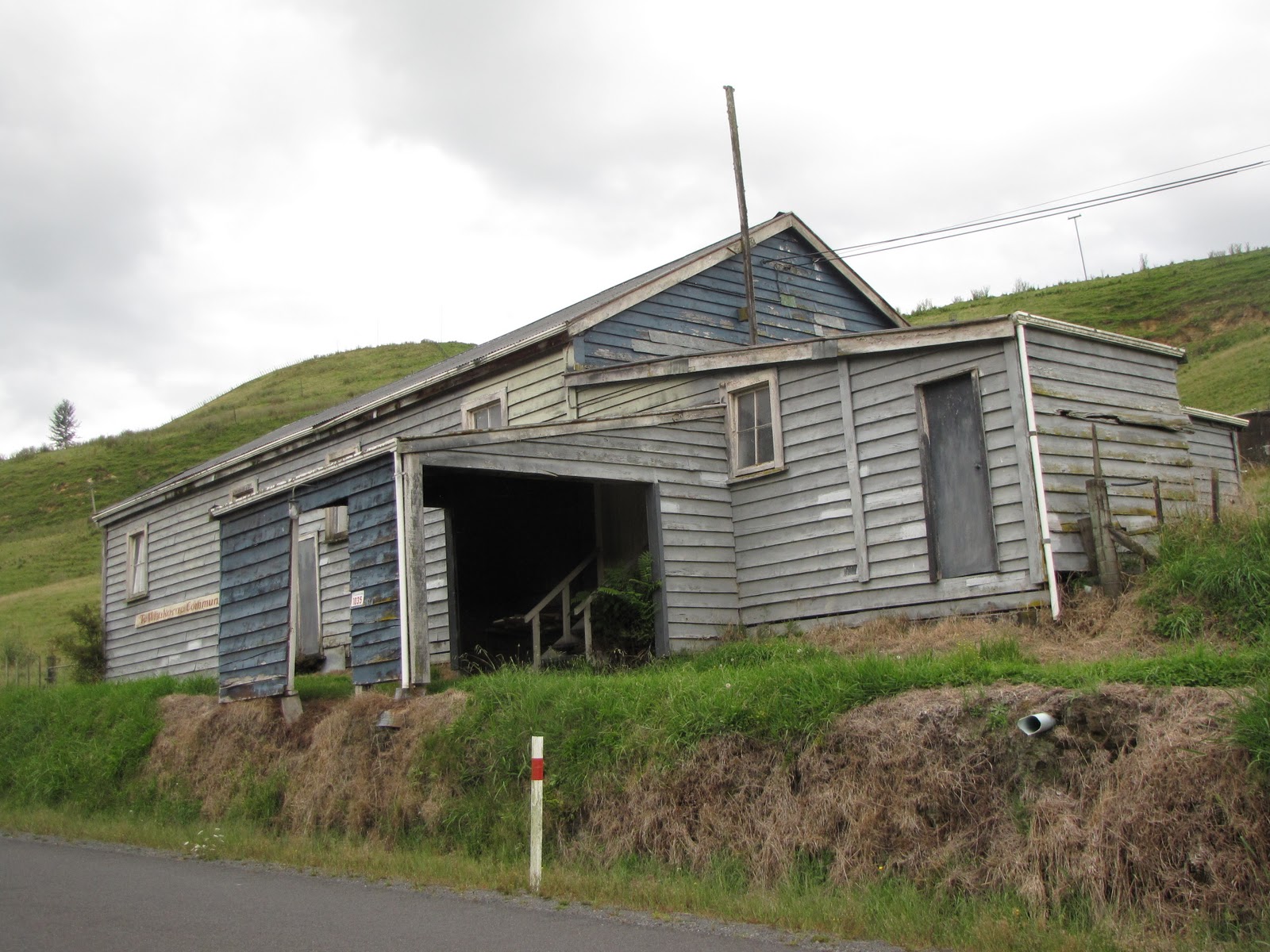
Feeling sad and emotional, I drove back down the valley road, across the ugly bridge, up past my old school site which is on the farm that once belonged to good friends, whose children I had spent many happy days with, ( one of the sons, Ross, married my cousin), the school closed down many years ago with the building being used as a haybarn, thats another crying story that I won`t get into yet !! Across the road from the school stands the Te Whakarae Hall, once the pride and joy of this  spread-out farming community, the scene of many country dances ( I can still see my parents getting dressed up in their best clothes, my mother with her bright lipstick, sparkly necklace and swirling dress ( it is the 50`s remember), my handsome Dad in strides and sports jacket), the men in one corner with the beer, the women around the kitchen end, fern leaves decorating the walls and powder on the wooden floor for dancing. This hall was used for meetings, Womens Division days, sports events, especially badminton tournaments, plus any school function was held there - now it is derelict and abandoned. . .  I know times have changed, life has moved on from those long summer days, but you know, I do wonder if it is always for the best, there was such a sense of belonging .. it did tug on my heart strings.

Wednesday, February 23, 2011

Tears for Christchurch - all NZ weeps . . .

All New Zealand weeps for our beautiful city Christchurch and her people. . .

A second major earthquake in 6 months has devastated the central part of the city with damage also across the city and surrounding areas. With the time of day ( 1.00pm) yesterday, and the fact that there was already damage from the Sept quake, many deaths and injuries have occurred. People are still trapped under huge piles of rubble, many buildings collapsed, it looks like a war zone you would see on tv in another place, not our peaceful, stunningly beautiful country. . .

There has been an out-pouring of grief, most of us either have family and friends living in CHCH or know someone who has, it is very hard for us as a people to get our heads around a disaster of this magnitude, we have has so few over the time of settlement. Godszone, that is what we have always been called  - safe and secure . . our world has been rocked and will never be the same again ..

Thursday, February 10, 2011

I love Trees

Isn`t she beautiful ? This old cherry tree grows in Memorial Park along side the Waikato river which runs through my city. She is literally being held together with leather straps and a post ! With giant cracks and bora holes in the stumps, this old tree still manages to put on a stunning display of blossom in the spring and a leafy canopy over summer. 
Held together with a large band and metal clip sort of thingie - this and the post is holding the tree together and from the branches hitting the ground.
It took me awhile to find this tag, but I am glad I did and very pleased to see my old tree protected - Hamilton does not have a good record when it comes to protecting trees . . . I have known of many 100yr old and older trees that have been cut down by developers, really sad as we don`t have that many old trees, they were planted by the Hamilton Beautification Society in the late 1800 early 1900`s, these are mainly exotics - lots of Elms, Oaks and other English species were grown and planted.
Even with a long crack in the branch the old tree still manages to grow new wood each year, bloom beautifully and contribute to our breathing with her leaves - trees are the earth`s lungs . .

Wednesday, February 2, 2011

Pressings . . .

One of my most loved past times is collecting, drying, pressing and mounting plant samples. I started my own herbarium ( collection of dried flora) 10 years ago when I went back to study, for part of my horticultural course I had to collect 100 different species of trees, shrubs, natives, annuals and bulbs, identify them correctly, dry and press them and write the corect infomation, including their latin names ! I found a passion I never knew I had, since then I have continued to add to my herbarium which has come in very handy a number of times when I needed to identify a plant.
I find some of the pressings are so beautiful I want to frame them so I can enjoy them all the time ! 
Pansy flowers are so easy to press - pick up a book out of my library and you more then likely will have a pansy or two drop into your lap, all dried softly crinkled and smelling faintly of the garden - summer memories ..  
Even seed heads from common little garden plants look amazing - their beauty lasts for such a long time, especially if the herbarium is kept in a dry airy place, don`t ever get it damp as some plants can mildue very quickly.
I use tiny daps of a clear craft glue to attach the plant material to the acid-free paper once I make certain all of the plant is completely pressed, laying the plant on the paper in a natural position. If the leaves are to long or wide cut them straight along the edge of the paper. Another thing to look for is the different undersides of leaves, turn one over to display. 
The job I would give my back teeth for is to work in a famous herbarium like Kew Gardens in the UK or maybe at the museum in Auckland here in NZ - anywhere there is a pile of dried, dusty old plants . .

Tuesday, January 25, 2011

Precious Memories

MEMORIES


Most of my school holidays from the age of 7yrs until we left the King Country when I was 13yrs old were spent with my Grandmother. (Nana)


Breakfast in bed, a luxury never allowed at home, singing together and hours spent pouring over old photo albums and reliving her childhood, these things I remember so clearly. This woman wrapped me up in a cocoon of love and safety. She taught me to look at the smallest things on our long walks, insects, leaves and stones gathered up and arranged neatly on the table, where we discussed and marvelled at the beauty. Sitting out on the front steps in the sun, brushing her long white hair, plaiting and re-plaiting, tying it up in all sorts of strange ways – she even used to let me pluck her eyebrows!


Every week day morning at precisely 10.00 am we sat down with a cup of tea and usually a large slice of deliciously light sponge cake, made with blue shelled duck eggs, baked in an old coal range, to listen to `Doctor Paul` and ` Portia faces Life`, both long running radio serials which my Nana never missed and I became enthralled with. For an hour we forgot where we were, the sound of dogs barking and my Grandfather's gruff voice bringing us back to reality.


The farm house was built at the end of a very long driveway which meandered up a steep clay hillside. Planted in large groups were many exotic trees including wonderful Liquidambars which glowed red, yellow and orange in autumn. I can never see these trees now without instantly being transported in my mind, back to my Grandmothers home. After the leaves had fallen the hillsides were smothered in huge yellow daffodils, another memory I treasure. Nana and I in our coats and gumboots early in the morning picking armfuls of sweet smelling daffodils for the house and to give to her elderly neighbours a mile or so down the valley.


Nana had a pet Paradise duck called Milly. This spoilt pet followed her everywhere, even inside if she could. Every May my Grandfather and 2 uncles, Paul and Ian, would go duck shooting on the dam at the back of the farm, one year they brought home this tiny duckling – an unusual thing for these men to do as they were not really into pets, except maybe for the fox terrier the boys had and even she had to earn her living by chasing rabbits out of burrows to be caught in a net. My Grandfathers working dogs were certainly not made a fuss of, they were never allowed inside the back gate.

Milly however, became Queen of the house and garden, the dogs were very wary of her , the cat never went near her after the first and only run-in they had – the duck won! Milly was so expressive, she had a large repertoire of calls and she was a very good watchdog. If she didn't recognise someone they ended up dancing from foot to foot trying to escape the peaking beak and strong flapping wings. She adored my Grandmother, they could often be found sitting together on the front porch in the late afternoon sun, Nana snoozing and Milly dreaming with tiny soft noises.

Paradise ducks mate for life, when Milly found her mate and eventually left, Nana missed her very much but I think the slugs and snails in the garden were happy she had gone.


My two youngest uncles are only 4 and 5 years older then me, my Mother being one of the oldest of the eight children my Grandparents had. These two boys used every opportunity they had to tease me unmercifully. If they weren't sitting on me and tickling me till I cried, they were frightening me with awful scary stories. I remember their outside bedroom with the walls covered in deer and pig heads and their guitars and mouth organs I was told never to touch – well, that proved an irresistible reason to sneak in while they were not there and touch these forbidden musical instruments. They were both crack shots with a 22 rifle and also deadly with slingshots, practising every day with tin cans lined up along the fence posts. Possum shooting was an experience with these two boys, being allowed out after midnight into the dark, thousands of stars and the sound of silence, a huge adventure. The foxy would bail a possum up high in the poplars or macrocarpa hedge with a lot of hysterical barking, a single shot and dull thud as the dead animal hit the ground – another skin to add to the pile that would be sold to the local buyer for one shilling each. For the mighty privilege of being there I had to carry the smelly, blood dripping carcase home, running to keep up with the boys but never complaining..


My Grandmother died in Sept 1982, I was heavily pregnant with my 2nd daughter.. I still feel her loss keenly, a week later Pip was born, my tiny daughter who has her Great Grandmothers name in hers, Phillippa Claire Gwendoline and who has inherited the same gentle nature and sweet smile.


I see the likeness of my Grandmother in my three daughters faces, I see the gentle smile and bright eyes and feel the loving nature. I know she watches over me, and often feel her presence. I remember the words she spoke and I am forever thankful she was in my life.


Saturday, January 22, 2011

Hives


Bee hives my daughter, Meg, painted in one of her latest paintings - she is not sure why !
Posted by Picasa

Friday, January 21, 2011

endless love . .

This beautiful card was made for me by my then 13yr old granddaughter, Lia, before she left to stay with her Dad for 6 months last year. I must admit, I didn`t notice the missing `e` for some time ! This, along with other cards made for me by my children and grandchildren are very precious to me, I have a journal in which I put bits and pieces that mean alot to me, including poetry, pressed plants, photos and other bits of my life ..
I was secretly very chuffed with the lovely message Lia wrote, it always brings tears to my eyes, it is amazing what an influence grandparents can have with their grandchildren, all it takes is time spent with them, endless love, which is not hard to give - in fact I am hopeless, I hate when they cry, I want to make it better and love them to pieces -  they know it to . .

Wednesday, January 19, 2011

Garden Pretties ..

This NZ bush scene is . . . . from the loo window in the very nice new toilets at the Hamilton Gardens - it must seem, to those that follow this blog, that I visit no where else in my lovely city or country - not true, but I do work at the Wintec Hort campus which is sited within the Gardens, hence many pics !!
After my friend Cally and I had lunch at the Garden cafe yesterday, we went for a walk through the Te Parapara Maori garden as Cally had not seen it completed. Her observant eyes saw these clever flax flowers woven by someone through the garden, all still connected to the leaves and plant - really cool idea we thought ! NZ flax Phormium tenax grows everywhere in this country, had many uses for Maori, including clothing,baskets, utensils, medicine,walls in the wharenui, roofing material and dried flower stems burn well. Before collecting the flax leaves or blades, always by women, there was a strict ritual to follow, never were the plants destroyed or damaged in any way while collecting, the old Maori knew their lives depended on this hardy plant. Many people learn how to weave with this plant even today - hence the flax flowers . .
The beautifully lobed bright green above, silver below leaves of the Paper Mulberry Broussonetia papyrifera known as Aute by Maori, was brought to Aotearoa by the first Polynesians. It was used to make cloth from the inner bark, known as Tapa in other Pacific islands, it didn`t grown well here as our winters were to cold. It is a glorious tropical plant with amazing textured leaves, some with lobes , others shaped quite differently. Not sure how it will do in our frosty winters.
In the walled vegetable garden at the H Gardens there are 4 large beds and gardens down each side, planted with many different veges, boarded with different annuals including these sunflowers. I managed to get this bumble bee to sit still for a moment. If you can get to the Hamilton Gardens you really should, they are looking incredible ! The gardeners work so very hard to keep this jewel in our city`s crown an absolute work of art - any time of the year it is a stunning picture . . .I am forever grateful that early city forefathers had the insight to carve this paradise out of what was amongst other things, the dump !

Wednesday, January 12, 2011

Natural Beauty .. .

On my early morning walk through the Hamilton Gardens this morning, all the plants looked bright with water ( earlier irrigation!) and morning light. No one else around, not even the gardeners, just the birds and me . . . . really soul restoring for this woman. In the Te Parapara Maori garden, the gourd vines are flowering, with tiny gourds (above) starting to develop. The flower (below) is elegant and defined, the tendrils light green, clinging to the wooden palisades - I do hope the public leaves them alone to mature. 
Snow white papery petals with a lime green centre, gourd flowers are simply stunning, I had never taken much notice of them before, against the light green foliage and wood background, these flowers really stand out - nature so beautifully designed. 
A small fence surrounds different stones placed in certain positions at one corner of the Maori garden, with gourd vines trailing over and through the kanuka fence.    
The American Modernist garden has plants from the western area of the USA, including the stunning Romneya coulteri or Californian Tree Poppy, a tall stunning perennial which once established, can spread quickly. Above is the bud, below the brilliant white crepe like flower with a strong yellow centre. While checking out the flora I spied a baby hedgehog trying desperately to get out of the empty pond, it instantly curled into a ball while I picked it up gingerly, by one prickle, and put it into the bushes. The gardeners often find them drowned in the water features that abound through-out the gardens, hedgehogs are not native to NZ, brought in by early settlers in the 1800`s to eat the snails and slugs that were also imported !! Afew hedgies probably hitched a ride on sailing ships also. 
There were quite afew bumblebees on these great looking flowers this morning, it was to early for honeybees to be out, but the dear old bumbles were busy working the flowers, bright yellow pollen bags full and fuzzy pollen dusted bodies. I tried to get some decent pics, but I wasn`t quick enough.
Looking through to the Romulus and Reamus statue with the female wolf feeding the twins and her cave in behind. This area is attach to the Italian garden entered via the garden or through a beech covered tunnel effect, the high pagoda covered in a non-fruiting grape vine, beautiful autumn colour.Click on the pics to see detail, the lawns here have almond, fig and olive trees planted in them.It is always interesting speaking to people visiting the gardens, at how many don`t know the story behind the lost babies brought up by wolves, I must be getting old cause I learn`t it at school !

Saturday, January 8, 2011

Love to Last . . .

I just love old gravestones - don`t you ? I found this beautiful heart-shaped gravestone in the old Hamilton East cemetery recently and even though I can`t read the inscription, I spent ages sitting next to it imagining . . .  Was it a devastated husband`s last symbol of love for his young wife, or a child`s grave ?
I often walk through this early Hamilton resting place and think about the people lying here - many deaths by drowning in the Waikato river, falls from horses and diseases now obliterated, not that many from old age. One that always makes me feel very sad has 4 children, aged from 6 to newborn, all lost from some unimaginable illness.

Cemeteries are excellent social barometers, if you take the time to walk through, taking notice of dates, the centuries unfold. There have been no recent burials, so much of Hamilton`s early history rest on the hillside, it is worth a visit to reflect . . .

Saturday, January 1, 2011

Reflections not Resolutions . . .

Today has been a quiet day, a day to reflect over the past year, to be honest, over the past few years really. The weather has been beautiful, not hot, just nice with a breeze that dried the washing and kept the cats warm in its rays.

Being home alone, meant National Radio playing all day, soothing, interesting music and a very funny American play, the NZ songwriter, Anika Moa with her new album. The news every hour spoken in a perfect radio voice, so many memories of listening to the radio as a child, hearing the BBC voices !

Being home alone meant coffee and the garden mag, sitting outside in the morning sun, watching the blackbirds flicking through the mulch and screaming at the cats ( birds that is) with that awful alarm call - I swear the cats smile . .

Being home alone meant snoozing on the sofa after trying to read the Hamilton Garden Festival programme - so many fantastic plays, music and other things to go to in Feb.

Being home alone meant time to reflect . . . think about happenings in my life, mainly, grown children leaving to live further away for a new start, another daughter who needs time and space to sort her life out - I feel I need to draw back, somehow trying not to worry, my baby`s 2nd year at Uni and living away from home - my first time really alone last year since I left home at 17 . My beautiful grandchildren who are my delight. But mainly, I would like to think I could make some inroads into dealing with a major family relationship, one that should play a huge part in my life, but one I have had to distance myself from to survive . .

Being home alone gives me time and energy to think about new ways of dealing with stress and unhappiness and JOY - something I know I deserve !

Bring on 2011

Wednesday, December 29, 2010

Summer Beach Walk . .

A beach path through the sand dunes, leading down to the wide open east coast beach - a scene etched in most New Zealander`s minds - the hot sand that has to be run and hoped quickly over, wild native grasses and` bunny tails` to be picked, brought home to sit in a glass to remind us of our holiday, along with the bag of smelly shells still with their inhabitants in - but after washing them out, if you listen carefully with the shell to your ear, you will hear the ocean, swishing in onto the sand . . .

 A man and his dog . . .  My son Cameron with Bella - both love this beach with a passion. Cameron surfs every day if he can, Bella runs and runs, chasing seagulls and shadows. Cameron, with his family, lives a couple of blocks back from the beach, he reckons by the time he is 40, they will be living on the beach ! 

 Looking back along the beach towards the Maunga (Mt Manganui) with the distant Kaimai ranges in a blue haze - these are the ranges I have to travel over from my lush Waikato valley to the east coast - this long range of hills are like a spine down the side of the North Island, starting in the Coromandel, running right through, separated by narrow valleys and with a different name as they spread.
I must admit, I do have a stronger `pull` to the west coast of NZ, it is wilder, has black sand mostly, with a strong and distinct feel about it - the east coast is lovely but abit too tame for me. I love the wind and crashing waves of the west coast - might be something to do with all the iron in the sand or even my Irish heritage - who knows . . .

Monday, December 27, 2010

Flower Creations . . .

A new sunflower beginning to emerge, all tightly curled and twisted, slowly unfurling to become the beautiful `sun` shaped flower we all recognize - rather lovely I think . . . .

My favorite seat in the Herb Garden down in Hamilton Gardens surrounded by flowering herbs, the tall yellow flowers being Elecampane. also known as Horseheal, Scabwort and wild sunflower. The bright yellow daisy-like flowers (below) attract bees and other pollinating insects, the roots of this plant being used by herbalists to treat stomach ailments in ancient Greek and Roman times, still used by vets to treat skin diseases on animals.


Globe artichoke, one of my favorite structural plants in either the vege or flower garden, the intense blue/purple flowers with the amazing silver leaves, tall and striking in any garden - an acquired taste for the palate.

Tuesday, December 21, 2010

A Little Night Time Reading . . .

My bedside chair is groaning under the weight of Books, National Geographics, Organic Mags, Horticultural bits and pieces, even an Arboriculture Mag which has fascinating articles on all things `trees`, plus my latest bee read, `The Buzz about Bees` by Jurgen Tautz which I can`t wait to have time to start reading, all the reviews I have read about this book have been very positive, informative and enlightening.
Another book that arrived in the mail this month ( I am an absolute push-over for books) is `Natural Beekeeping` by Ross Conrad, an excellent book I have been wanting to have in my `natural beekeeping` library for ages. It is so good to have my thoughts and ideas on natural beekeeping reafirmed by other people who have been practicing this way of keeping bees - there is precious little advice or information here in NZ, I am hoping that will change in the near future - I`m not really holding my breath tho !!

Thursday, December 16, 2010

Elderberry Clouds . . .

Elderberry (Sambucus nigra) flowers . . . beautifully scented floating clouds above dark green leaves, followed by small dark berries that make delicious wine and jam. I brought a bottle of Elderberry cordial at the Raglan market last Sunday, mixed with soda water it makes the most delicious, refreshing drink.                       
    
   Herbalists have for generations been aware of the benefits of using elderberry syrup for cough and congestion remedies, herbal teas for relieving sore throats, also used as a mild laxative or diuretic. Evidence of the cultivation of Elderberry has been found at stone-age village sites in Switzerland and Italy. It was also imbued with myth and magic, spirits were said to live in the tree, people refused to cut it down or burn the wood. The leaves were once used in green elder ointment for bruises, sprains, and wounds. 
There is a wealth of folklore attached to this plant, often described as a `complete medical chest` because of its countless therapeutic qualities, one being the use of elderberry water for whitening the skin and removing freckles !


Elderberry is considered a weed here in NZ as are so many other exotic plants introduced over the last 100 yrs. Being a mostly temperate climate and fertile soils, plants get out of control quickly, moving into our native bush and smothering everything.     

 
Raw elderberries should not be eaten as the seeds contain an un-pleasant tasting, poisonous alkaloid, cooked they are used in jams, sauces, jellies and syrups. Fresh elderberry flower clusters make delicious fritters !  
The old wood is very hard, it was used for making nails for the soles of shoes, the young wood is brittle and soft, often hollowed out to make pipes and musical instruments.    
A tree of many uses, elderberry may be considered a pest, but it is one of my favorite plants.


Friday, December 10, 2010

NZ Bee Plants

The 2 photos above are of our native Manuka  Leptospermum scoparium , a scrubby bush that grows all over the country. Once thought of as a weed by farmers, my father spent many days `scrub cutting`and burning manuka off the steep hills, later sowing  grass seed, it is now considered NZ`s best honey producing plant !! Beekeepers have been known to helicopter hives into very isolated valleys and hillsides to capture the nectar from this flower. Manuka honey is now used in medicine all over the world, pioneered by our own Dr Peter Molan from Waikato University, here in Hamilton. The dark, strong flavored honey is probably the most expensive to buy here in NZ, with most of it exported overseas.       


Native flax Phormium tenax is another widely grown NZ plant that bees love gathering the pollen and nectar from. Birds love it to, even starlings can be seen with a yellow head after dipping in for the treat. Maori used the strong fibrous leaves of flax to weave into clothing, decorative panels, water proof roofing, utensils, just about everything. It was the only plant that was available for them to use in this cool, temperate land, no big animals for skins, just lots of amazing birds that either didn`t fly or hopped through the trees, having no natural predators until man arrived ! Flax also has many excellent medicinal properties, animals will naturally self-medicate with flax leaves if able to access it.
There are a number of hybrid species, with P.cookianum the mountain flax, smaller then P.tenax planted alot in gardens. Many of our NZ native plants can be found growing all over the world these days, I always smile when I see flax or cabbage trees growing in cold countries, sometimes having to be wrapped up for winter !